Le Bananier Bleu: The Zawinul Syndicate is now more than fifteen years old. First of all, why did you decide to call it “Syndicate”?
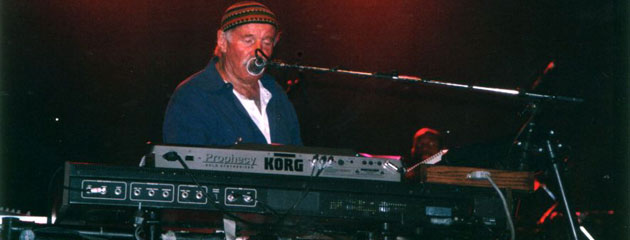
Joe Zawinul: We started in 87, so that makes it 17 years old. I’ll tell you something; I wanted to have a band. Weather Report was together 15 some years. And when we finished, it was a wonderful time to finish. We finished as best friends. Our contract with Sony, or CBS at that time, was over. The reason was, we were so successful until the very last time – there was never a point that we were not successful – but we were suffocated by the name Weather Report. Everybody knew Weather Report, but nobody knew who Wayne Shorter was and Joe Zawinul, who was he, you know? And after a while, Wayne and me, we talked about that, and we said that was not correct. We got to go out on our own; we cannot just keep on going like this. Then he just called his group by his name, and I wanted to have a collective name, because Weather Report was such a family, so I wanted to have a name that would recall a family, so I called it Syndicate, because, in a way, it’s a family also.
LBB: Would you say now that there is a main direction for this concept?
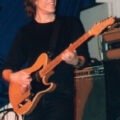
JZ: I cannot say that. I heard nobody doing what we were doing. Nobody. And that’s not easy to do. You know, there is something about playing this music. First of all, you have to be a musician, who can play the instrument. But then, you have to forget about that. We were storytellers. We were not just playing a tune, and then the next tune. There was always a line going. We were telling stories, and that’s what I still do. It is my music we play, with a couple of exceptions, but, how it is interpreted is very important. For about the last ten years I have found myself very close to African musicians. In America there are great musicians and many of them grew with Weather Report. And this was very obvious whenever they played you could say that it was Weather Report that sounds like this. But, the Africans came out of their own traditions. They also took a lot of what we did with Weather Report, but they put a little of their own little spice in the music, and therefore, I have a lot of them playing with me. The guys playing with me are from many different places in the world. I have had the same guitar player, for seven or eight years now. His name is Amit Chatterjee, and he is from Calcutta. When he was twelve years old, he came to America withhis parents. He is a great great musician, one of the best pure singers I have ever heard. And he is also part of my symphonic project, “Stories of the Danube”. We have a young drummer from Brooklyn, New York, Nathaniel Townsley. He played the last few years with Richard Bona, who was a member of my band too.
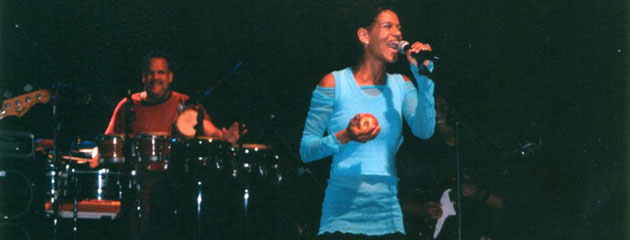 LBB: There are two new musicians in your band, Linley Marthe and Sabine Kabongo.
JZ: Yeah! Manolo Badrena is still with us, and now for the past year, we have had a phenomenal young bass player, Linley Marthe. He is from Mauritius, and people will hear about him! For me, Sabine Kabongo is just unbelievable. She is one of the major talents of any kind or era. You know, sometime you will have to see her. With Sabine Kabongo, everything is already there. She was in the group Zap Mama.
LBB: Africa obviously plays a big part in your music. It seems to me that you have a lot of African influences.
JZ: Not so much. I’ll tell you the truth, and I only realize that now. My African influences are much less than my influence on African musicians, because they grew up with my music, and I did not grew up with their music. I am not a music listener. Until I met Salif Keita, I had not heard any African music. That’s how it is. These young guys like Youssou N’dour, Salif, the guys in South Africa, in Nigeria, they grew up with Weather Report. And they added this to their traditional music and then it became what has been called World Music. And sometimes now, people ask me : “Well Mr. Zawinul, now are you playing world music?” But that’s not true, it is the other way around. I have spent time with Paco Séry and Etienne M’bappé who told me they said they spent days and days listening to Weather Report, and they knew everything we did. It’s important to tell to people what the truth is.
LBB: Amit Chatterjee and Nathaniel Townsley have been with you for a long time. Did they evolve with you? Has their contribution to the music increased?
JZ: Chatterjee was with us from 91 to 93, and then he left for a while. He came back in 96, and then left again. And now he has been with us since 97. And he absolutely evolved with us and contributes a lot. That’s the thing, I have musicians from different places in the world. This is different, because Weather Report was more or less an American band and I was the only foreigner in it. I have found that young American musicians have gone in their own direction (hardly influenced by the recording companies) to continue playing bebop, and bring bebop back. I think this was a major mistake, because, what it did was stop everything. Musicians, in other parts in the world, from Argentina to Australia, to China, or Turkey, they come from Weather Report. And on top of this, they built. They also heard bebop, but they didn’t want to be bebop musicians. Because we had freed music. We were the ones who took the chains off the music. You got to get away from the system. Four bars, repeat an A, middle part, and then the last eight bars of music… first solo is the saxophone, and then trumpet, piano, bass solo, 4/4 on the drums etc. We stopped all that! And the funny thing is that Wayne Shorter and myself independently changed the bar lines of the music. And we have been very successful in what we’ve done. Today there’s the rest of the world… America’s still America. There are great musicians there, but let’s say just in progressive music I don’t know anybody right now there I would spend money on. But in other parts of the world they bring all their traditions to the music and together with American tradition, and with what we did with Weather Report. And it is fresh! In France, in England, everywhere there are very good players. In America, they’re playing good too, but there are only a few who really went in the direction I talked about. There are guys like Christian McBride and some others who took up where we left off and went in another direction. I like very much what they are doing. I don’t like people playing bebop piano, bebop lines like in the 40’s.
 LBB: Do you still add tapes to your huge stock, which you use to build new tunes?
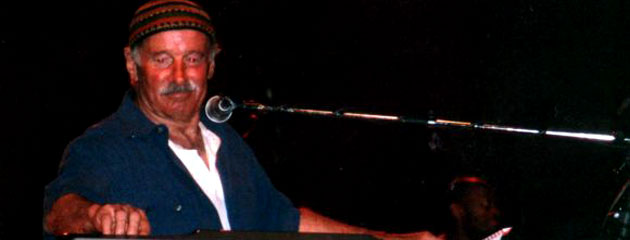
JZ: Not anymore, unfortunately. Everyday, I still record tapes, I have thousands of them. But with the new technologies, I don’t pick them up anymore. You know I’m an improviser. I improvise and then I write the music. But with the new technologies, I just play into the computer, and I don’t even change it for the record. You know “Faces and Places”, that’s what I did for everything I played on this record. I have about seven hundred new tunes I’m working on! Everyday I could have enough music for a CD.
LBB: And have you already planned your next CD?
JZ: Yes. But we have just a little problem. We made a wonderful DVD, in Surround Sound. It was recorded two years ago for my 70th birthday at the Leverkuhsen Jazz Fest. It was a great concert, with the whole band: Paco Séry, Etienne M’bappé, Sabine Kabongo, Amit Chatterjee, Manolo, too, Alex Acuña, special guest, Maria Joao. And the West German big band did five pieces from Weather Report, with Vince Mendoza conducting, Peter Erskine playing drums, Alex Acuña percussions, Victor Bailey on bass. This whole combination is on DVD. But something happened with the record company. One part of the company went out of business, and now we have to wait. But it’s coming out, perhaps in a month or so.
LBB: Do you listen to music?
JZ: No, I don’t listen to music. It’s not a question of time. I need headspace. I make music everyday, I think about music for this or that. But on the other hand, I won’t tell anybody who’s listening to music to turn it down or tell musicians to stop playing.
LBB: You have also played classical music, with Friedrich Gulda for example. You wrote a symphonic work too. Is there a frontier between these styles?
JZ: There is no difference for me. There is no change, and it’s just different instruments.
LBB: Thank you very much, Joe.
JZ: Thank you.
Entretien réalisé le 3 avril 2004
Lire le compte rendu d’Alain Joséphine dans la rubrique “Ut musica…”